The Plexiglass Economy · Part 2 of 3
The Plexiglass Fortress Next Door
When theft gets bad enough, Philadelphia corner stores put up plexiglass and lock the cases. At a 2-5% net margin, the response costs more than the theft.
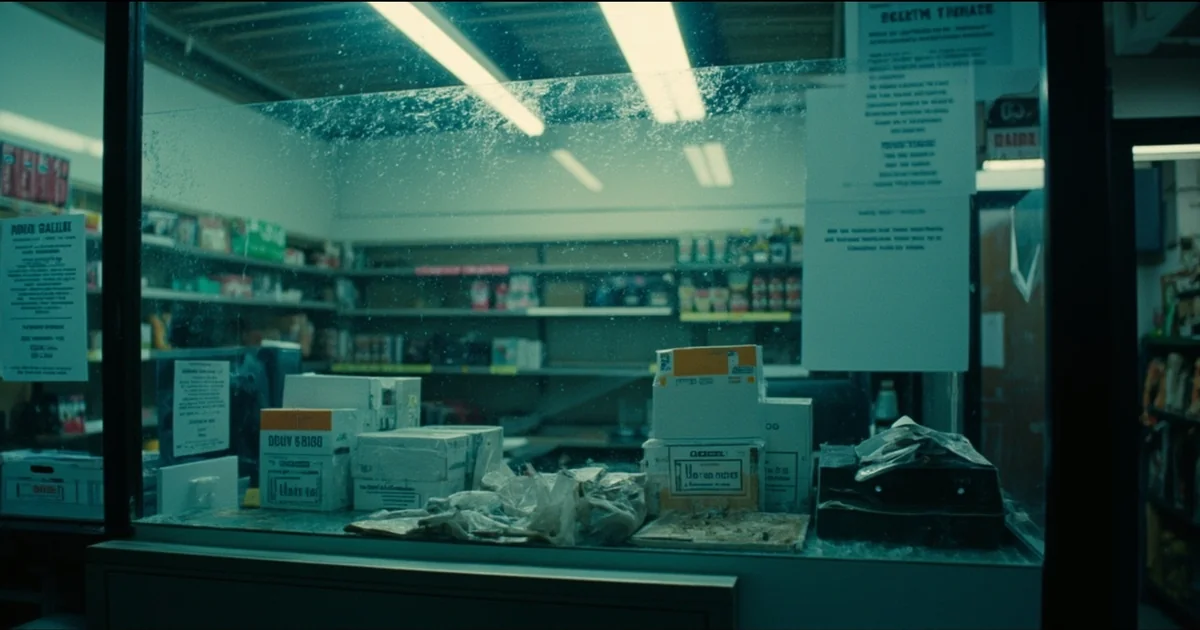
My first essay on retail theft walked through the tough math, how small amounts of theft can be absolutely devestating on retailers, which operate on tiny margins. A corner grocery store may operate on just a 2-5% margin, so $50 of daily theft can eat up most or all of the store's annual profits.
The math is tough, but the math misses the mark on telling the human impact of this theft, which results in a vicious cycle devestating both storeowners, law-abiding residents, and communities as a whole. When theft gets bad enough, stores adapt and change. The most common adaptations are to make it hard to steal: they put up walls, they lock the cases, and they change the relationship of the store with its community, from that of community member to jail warden. And the experience of shopping decays, followed soon by the decay and death of the store itself.
The Owner's Defense is the Fortress, which devestates the shopping experience
Walk through any neighborhood in West or North Philadelphia and you can see it. The open-counter corner store is disappearing. In its place: a wall of plexiglass between the clerk and the customer, transactions through a slot, snacks locked in cases. The clerk reaches behind them for what you want rather than letting you browse.
Stores are becoming forts. When you walked into a store, you were really buying two things: the experience of shopping, of browsing and of exploring; and the actual utility of buying something you needed or wanted. A lot of what you were paying for was the first, which is exactly what the walls take away.
The Fortress is not free for the owner either
Plexiglass isn't free. Neither are the shelf locks, the cameras, or the security guard. Nor is time staff spend unlocking and locking every case for customers. When you run a 30% gross margin business like in retail, every dollar in additional security spend requires about $3.30 in additional sales to break even, and usually adding security lowers sales because of the experiential reasons I talked through above.
But the cost is not simply financial. The real wound is to the community, and is what naturally happens next. A store shaped like a fortress sells differently than a store shaped like a corner mercado. The customer who used to browse, pick up an extra item, and maybe linger now buys what they need and leaves; the clerk who used to nod and make small talk is a mechanical turk under what is de facto a vending machine slot.
Customers notice the increase in prices caused by the additional security costs. A bag of Lay's chips costs $3.29 at the CVS on Market Street and $5.99 at the corner store on 52nd. Oh, and the first makes you feel like you're in a prison and the second one makes you feel like you're in a prison commissary. Not a great experience and definitely not one you want to pay an 82% premium for.
The Fortress Kills the Store
Fortress stores sell less, because each transaction takes longer, fewer people enter the uninviting store, and people purchase less per visit since they don't make impulse purchases. In fancy retail language, this is called transaction velocity, foot traffic and basket size, respectively, which all decline. As those numbers decline, retailers jack up prices to stay profitable, which accelerates the cycle. And so the retailer enters the death spiral.
When that bodega closes, it affects the neighborhood and its residents. The nearest grocery might be a mile and a half away. In poorer neighborhoods where not everyone has a car, it means going grocery shopping means organizing your life around bus schedules. And thus, the food desert is created... from a bunch of people all doing the right thing from their own perspective, the store owner preventing theft, the customers wanting to pay lower prices, the community members not enjoying the Fortress in their midst.
The Vicious Cycle
In my first essay on this topic, I walked through the math of why retail is a tough business and how small amounts of theft are absolutely devestating in a way that those of us who have not run or owned a store imagine. When Macy's, a company selling $22.6 billion of stuff each year, actively discusses theft ratios on their earnings call, you learn it's important. When your neighborhood corner store disappears, you learn the hard way it matters.
The next essay, the one about policy, tries to explain why this was acceptable. Someone decided theft below a threshold wasn't worth prosecuting. It's just that the same arithmetic that makes sense in a conference room makes the corner store into a fortress, and the fortress into a gap in the neighborhood.
Notes, Sources, and Methodology
The margin figures in this essay are the operating assumptions the essay runs on for a corner store, recorded in the series' canonical dataset, analysis/data/plexiglass_facts.json: a 2-5% net margin and a 30% gross margin. The $3.30 figure is the sales needed to cover one dollar of security spend at that gross margin. The price comparison is my own observation of two shelves in West Philadelphia, not a price series.
Methodology details. The security cost is arithmetic on a 30% gross margin, since spend on a guard or a camera is recovered from incremental sales at the gross margin. It does not include the one-time capital cost of the plexiglass, the cases, or the camera, none of which is sourced. The store described throughout is illustrative, not a measured business.
Limitations. The margins are the essay's stated assumptions, not Philadelphia figures and not a measured store. The distances and travel times describe a neighborhood I lived in, and they are not from a transit dataset. Nothing here establishes that any particular store closed, or why.
https://nickjain.com/blog/retail-theft-plexiglass-economies