What the hell does Praise Dobler mean?
You see it all around Philly. Praise Dobler. I saw it a bunch of times and was wondering if he was a new religious prophet. He kinda is.
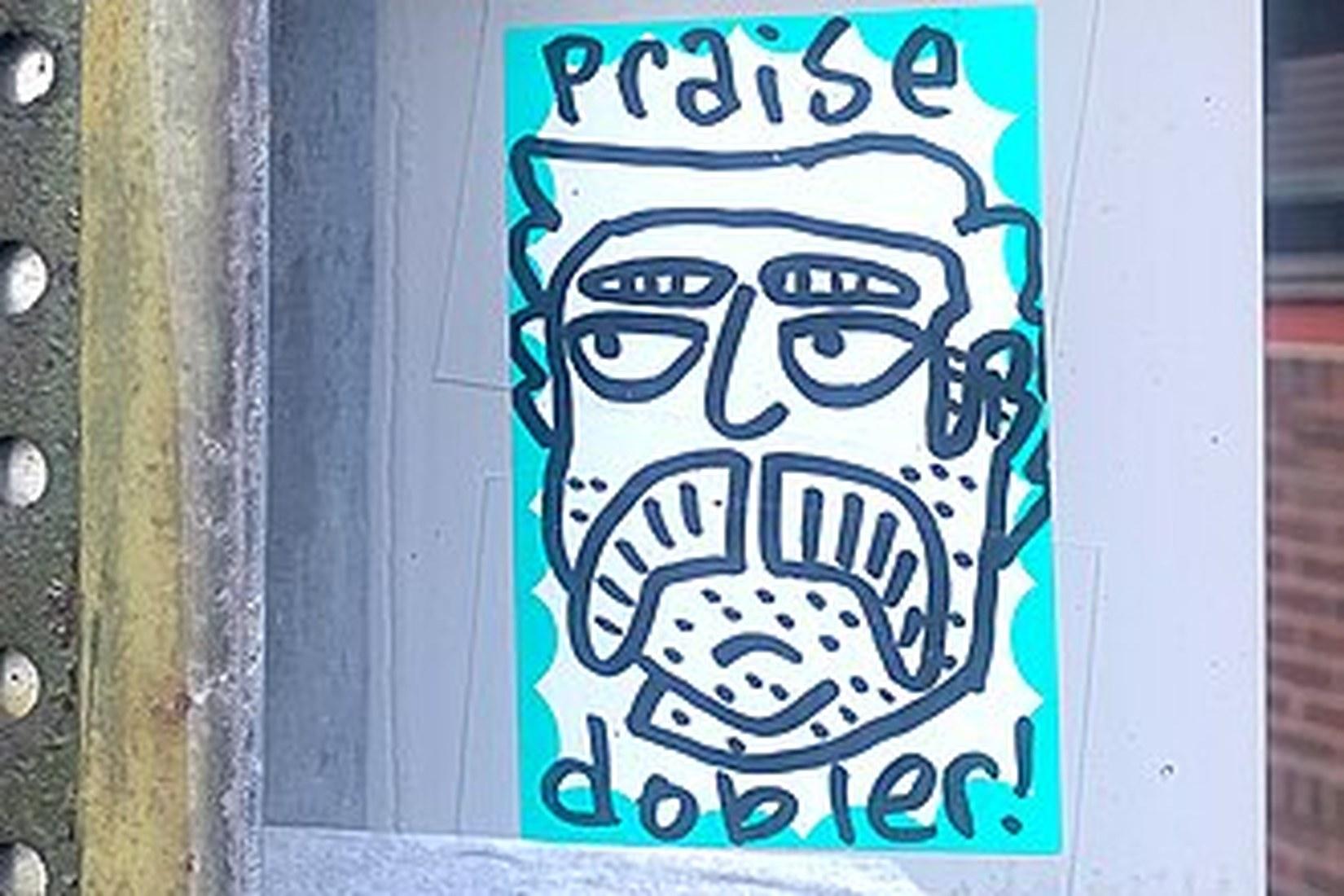
In a bunch of random places, from bus stops to lampposts to some El stops, you’ll see a sticker or some graffiti that says Praise Dobler. For the first few times that I saw it, I thought it was just some sort of internet meme. And then I thought maybe he was a new-world cult leader. And I ignored it.
I kept ignoring it until a few months ago, when I discovered someone had stuck a Praise Dobler sticker on my kid’s stroller while I’d left it unattended in a playground. Not in a damaging way, I wasn’t even annoyed. I was confused. Was it like the religious literature you get on car windshields, from someone trying to save my eternal soul? So I figured screw it, let’s figure out who Dobler is and whether I should in fact be praising him.
This Religion’s God Was Once Called Pro Football’s Dirtiest Player
So Dobler is a now-dead NFL offensive guard, Conrad Dobler. His “cult” was founded in a jail cell, by a jaded artist who needed a savior.
Conrad Dobler was born in Chicago in 1950 and died in Pueblo, Colorado on February 13, 2023. He played guard for the Cardinals, the Saints and the Bills, made three straight Pro Bowls, and in July 1977 got a Sports Illustrated cover that called him “Pro Football’s Dirtiest Player.” He punched and kicked other players, and spat at them. He even wrote a bio called They Call Me Dirty.
Some religions start in Mecca, others in Jerusalem and others in places long forgotten. Praise Dobler started in a Jail Cell
Then some artist, who now goes anonymously by the moniker Praise Dobler, apparently found Dobler’s mustached face in a box of cookies with football players on it. In a January 2025 Philadelphia Free Press interview the artist says they found Dobler’s face back in 2009, saying that they were arrested for a DUI and were court-ordered to attend recovery meetings. Then, in some sort of argument with a cellmate about how they needed external help to recover, they needed a savior, and, to paraphrase, weren’t quite feeling Jesus as their savior. So they figured, why not make up their own savior. And since they were making up religions and saviors anyway, why not pick the dirtiest-playing football player in the NFL. And so Conrad Dobler was apotheosized. He became a god worthy of praise.
The anonymous artist understands the absurdity of their religion. “I’m not actually crazy, I don’t actually pray to Dobler,” they said, “like, that’s just tongue-in-cheek.” But other people have taken it up as more than a joke. “Dobbler’s my higher power.” One of them asked Dobler to help sell a house and had an offer come in the next day, which the artist calls a miracle. You join the cult of Dobler by saying “Invite Him into your heart,” and converts are encouraged to grow an exaggerated mustache.
Then It Became a Philly Thing
So the religion of Dobler has grown and somewhere around 2018 it started becoming a Philly street art thing. The artist met Dobler that year at the National Polish-American Sports Hall of Fame in South Philadelphia and remembers him as friendly: “He was a nice guy, and he made a joke.” The anonymous artist, their friends and others started printing the Praise Dobler stickers and putting them up around Philly. There is even a Facebook page called the Transcendent True Faith Church of Dobler. The artist’s stated objective is painfully simple: “Literally to just spread the gospel [of Dobler] and save souls.”
Notes, Sources, and Methodology
The origin story comes from two interviews with the artist: “In Praise of Dobler” in the Philadelphia Free Press (January 20, 2025) and a Streets Dept interview (September 26, 2023). Conrad Dobler’s football record comes from Wikipedia.
Origin stories. The two interviews tell the origin two different ways and I could not find a document that settles it. For simplicity I combined them into one telling here. You can read them distinctly in the Free Press interview and the Streets Dept interview.
Limitations. The artist is anonymous and I did not speak to them myself, so everything about the origin story is secondhand. The two interviews use different pronouns for the artist, so I use they throughout.
https://nickjain.com/blog/praise-dobler