Blocks and Towers
My son builds towers and knocks them down, builds them and knocks them down. I've been thinking about what that means and why Kipling was right about triumph and disaster.
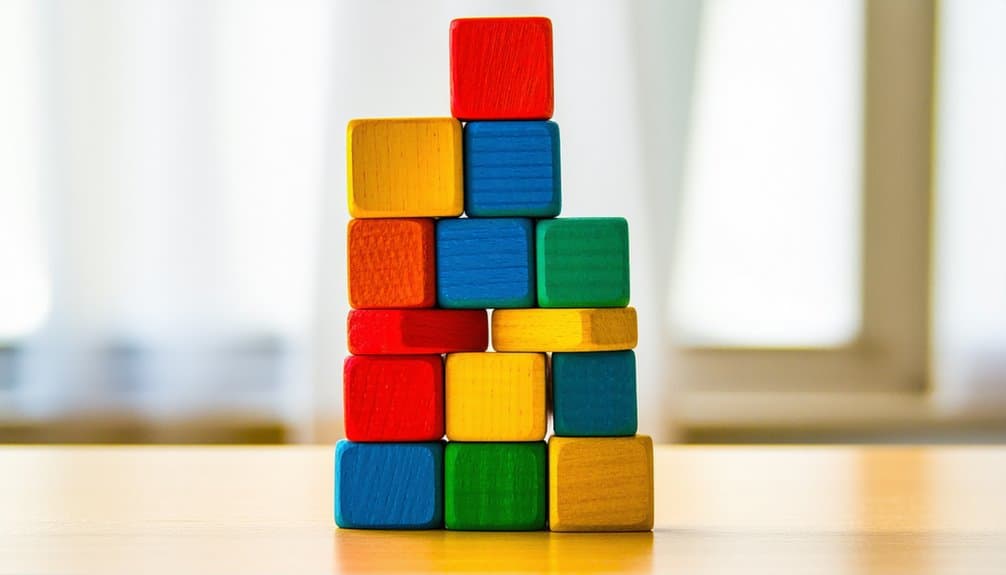
My son is almost two. He stacks blocks — wooden ones, primary colors, simple shapes. He'll get them two or three high and then knock them down. Then he builds them again. Then he knocks them down. Sometimes they fall down of their own accord. This happens over and over - and yet he appears completely satisfied.
When I knock his tower down, he doesn't get upset. He laughs. He gathers the blocks and builds again. When he knocks my tower down when I'm building next to him — same reaction. Delight.
He is careful when he stacks. He picks up each block, looks at it, sets it down, adjusts it. Sometimes the tower goes crooked and he fixes it before adding the next block. Sometimes it falls on its own because his stand is unsteady and jiggles the base. He starts over without complaint. The knocking down is usually intentional — it is something he does on purpose. He loves the loud, chaotic clattering of the falling blocks on our wooden floor. He watches the destruction, enjoys its, and begins again.
What got me was the part where I expected the disappointment that never came. The first time his tower fell on its own, I waited for the reaction — the slump, the look at me, the way I would have felt. Nothing. He picked up the blocks and started over. I kept waiting for it. It never came. That is what I have been thinking about for months.
Triumph and Disaster
Rudyard Kipling wrote: "If you can meet with Triumph and Disaster / And treat those two impostors just the same." I have read this poem many times over the years. I have it somewhere in a notebook. The line always stuck with me but I never fully understood it. I would say it to myself on a bad day, feel better for a moment, and then need to say it again.
Then I watched my son knock down a tower he had just built and laugh, and then build the same tower again in the same location with the same blocks, as if the destruction had never happened. For the first time, the line felt like something I had seen, not something I had been told.
He does the same thing with bigger problems — when I watched him descend the Art Museum steps at seven months old, no fear, just one step at a time, it was the same posture. Build, topple, build again. Climb, get distracted, keep climbing. The tower and the staircase are the same lesson.
He doesn't name the towers. He doesn't claim them. He builds them, uses them, and when they fall he just reaches for the next block.
What He Knows
I have been both of those people. The one who builds a tower and defends it forever, and the one who doesn't build again after it falls. I didn't realize how clearly I could see that in myself until I was sitting on the floor with my son, watching him knock down a tower he had just built and start over with the same blocks in the same spot. Watching him, I realized how much of my own identity I attach to the towers I build.
The part I did not expect was how the watching changed how I felt about my own falling towers. I have had them. I have mourned them. I have defended them. I am not sure I needed to do any of that. I am still working out what to do with that thought.
He is almost two. He doesn't know Kipling. He doesn't know what he is teaching me. He is just stacking blocks. I am just watching.