What Poker Teaches You About Thinking
The metacognitive lessons from the poker table — decision-making under uncertainty, belief updating, and the ego problem.
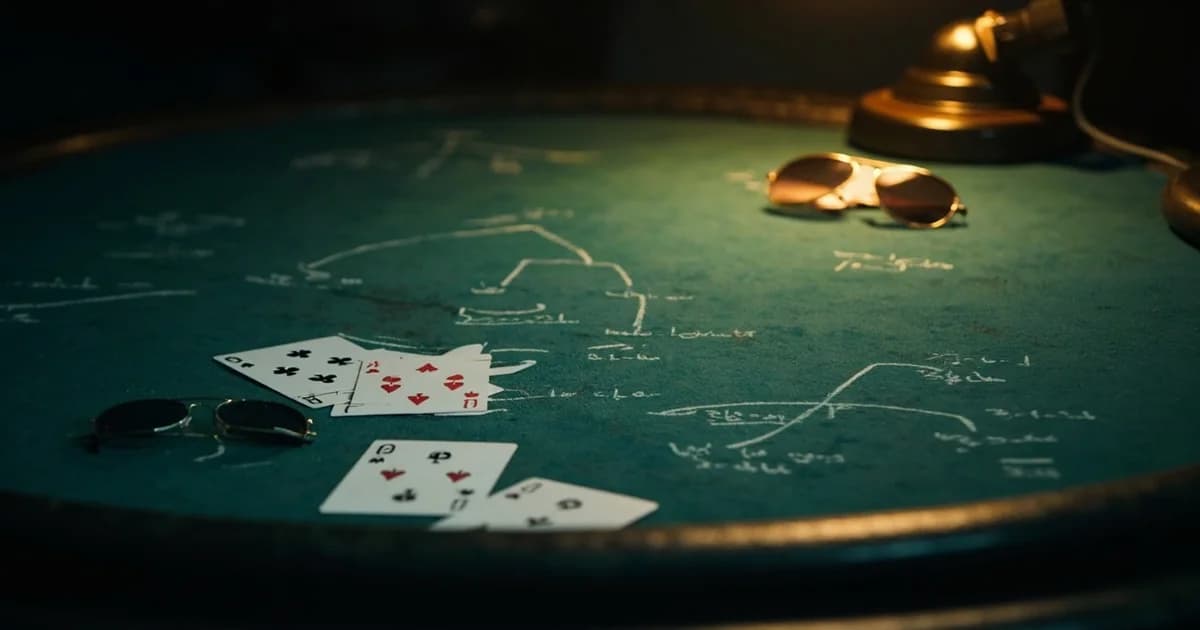
Poker looks like gambling. That is the first misreading. You sit down with chips, you get cards you did not choose, you wager on an outcome you cannot control. By that description, it sounds like a slot machine. Anyone who has played seriously knows the opposite is true. Poker is not a game of luck. It is a game of incomplete information, and that distinction contains almost everything worth knowing about thinking under uncertainty.
I came to poker in my late thirties, after a decade of building and selling businesses. I was attracted to it the way some people are attracted to mountain climbing — because I suspected it would teach me something about myself that I could not learn in a conference room. What I did not expect was how much it would rewire the way I thought about decision-making itself.
The Process Is the Point
The first lesson poker teaches, and the one most resisted by beginners, is that you cannot evaluate a decision by its outcome. This is almost philosophically offensive to how we are wired. The hand you folded lost, so the fold was wrong. The bluff you called won, so the call was right. This is how most people think. It is also exactly backward.
In poker, as in business, a good decision can produce a bad result and a bad decision can produce a good result. The skill is building a process robust enough that the math works out over time, regardless of what happens in any single hand. I have folded pocket aces because the board texture and my opponent's range made it correct. I lost that hand. The fold was still right. I have also called a raise with a weak hand, hit a miracle card, and won a large pot. The call was still wrong. The win was a gift from variance.
What this creates, if you let it, is a kind of cognitive immunity to outcome bias that is rare in business. When a project fails, the post-mortem is almost always contaminated by what happened rather than what should have happened given what was known at the time. Poker does not let you do this. The table keeps score in a way that eventually forces honesty on yourself.
Updating Your Beliefs in Real Time
Poker is Bayesian inference in real time. At the start of a hand, you know almost nothing. You have your two cards, and that is all. You assign probabilities to your opponent's range, you calculate expected value, you make a decision. Then the flop falls and the information changes. How long did it take your opponent to call? Did they reach for chips before or after looking at their cards? Each action is a data point, and the good player updates their model after every single one. The mediocre player picks a story at the start and defends it against all evidence to the contrary.
The business equivalents are constant. In the early days of a company, you play almost entirely on the flop — you have a thesis, some early customer signals, and a model you believe is roughly correct. Then reality arrives. The product your customers said they wanted is not the product they actually buy. The channel you thought would work flops. The good operators update. They fold the thesis that is not working and play the hand that the new information is dealing them. The poor operators double down because admitting the flop missed them feels like losing.
Buddy A understands this in a way that took me years to approximate. He spent twenty years in prison for a serious crime — not how any of this is supposed to begin, but hear me out. He came out having done something unusual with his time: he read. Milton. Melville. Philosophy, history, economics, carefully chosen. He plays poker now with the same economy he brings to everything. He does not play many hands. When he plays, you know it. There is a stillness to him at the table that experienced players recognize immediately and new players mistake for boredom or slowness. It is neither. He is updating. He reads the room the way you read a difficult paragraph: carefully, without assuming you already understand it. He has learned, in his words, to be comfortable being wrong, and that comfort is not an act. It is the source of every other skill he has.
Building Models From Nothing
When you sit down at a poker table with strangers — a new game, new players, no history — you face a problem that executives face constantly and rarely think about as a skill: how do you build a useful model when you have almost no information? You start from scratch. You observe. You watch who bets fast and who takes time. You notice who is playing with emotion and who is playing with calculation. The aggregate picture — built slowly, updated constantly — is what allows you to make decisions better than guesses.
The uncertainty at the start of a poker session is the same uncertainty at the start of any new business situation. You walk into a negotiation with no information about the other party's actual constraints, their BATNA, their emotional investment, their timeline. You build the model from nothing, and you update it as the conversation reveals things. The poker table is the same human situation with shorter time horizons and more legible feedback.
Most people treat uncertainty as an obstacle to be avoided or endured, not a condition to be engaged with productively. They want the information before they have to decide. But in poker as in business, the information comes while you are moving, not before. You build the model while the hand is in progress. You make the call before you are sure. The discomfort of acting on incomplete information is not a bug. It is the feature. It is the whole point. The people who can hold that discomfort longest are the ones who make the best decisions, because they are the ones who do not need certainty before they act.
The Ego Problem
Poker punishes confidence without competence the way few other activities do. There is a type of player — I have been them — who plays every hand as though folding is an admission of failure. They cannot bear to put cards in the mucker. They call raises with marginal holdings because folding feels like giving up, and giving up feels like losing in some interior way that has nothing to do with the chips. These players lose money over any meaningful sample. The hand they should have folded takes their stack. Their ego costs them and they do not learn from it because learning requires admitting the error, and the ego will not permit the admission.
The guy who cannot fold a losing hand is the same guy who cannot admit a project failed. I know this because I have been both guys at different times, and the cognitive mechanism is identical. It is the refusal to update — the insistence that the belief you started with must be correct because changing it feels like weakness. In poker, you watch this happen in real time. In business, it is the project that should have been killed in Q1 that limps through Q4 with the team doubled and the burn rate tripled, the executive still calling it a promising pilot.
Buddy A does not have this problem. When I ask him about a hand he folded that would have won, he shrugs — genuinely shrugs, not performatively — and says he made the right fold. He means it. The decision and the result are separate things, and conflating them is not just epistemically sloppy — it is expensive. His equanimity at the table is not a personality trait. It is the consequence of having learned what happens when you let your self-image determine your decisions.
The CEO Brain and the Poker Table
There is a reason the poker table has been called the best preparation for executive decision-making that exists. It is not about the cards. It is about the habits. The executive in a high-stakes meeting is making probabilistic judgments under time pressure with incomplete information, updating their model in real time as the other party reveals constraints, managing an emotional response to the possibility of being wrong — and then making the call. The table trains exactly this sequence of cognitive operations, under conditions of genuine uncertainty, with immediate and unambiguous feedback.
What poker develops is second-order awareness — the ability to notice not just what is happening, but to notice yourself happening. To catch the moment when your behavior shifts from calculation to defense. To notice that you are playing a hand not because the math is favorable but because folding would feel like an admission. That self-observation, that capacity to step back from your own cognitive process and examine it, is what separates players who improve over time from those who simply accumulate experience without learning from it.
The best poker players and the best business thinkers share one quality, and Buddy A embodies it completely: they have learned to be comfortable being wrong. Not comfortable with being wrong in the abstract — that is easy, nobody is bothered by abstractions — but comfortable in the moment of being wrong. Comfortable with the fold that costs you the pot. Comfortable with the call that turns out to have been a mistake. That comfort is not natural to human beings. It is trained, and poker trains it as well as anything I have found.
Milton understood this. Paradise Lost is, among other things, a poem about the cost of refusing to update your beliefs when the evidence changes. Satan's problem was compounding the error by building an identity around the first mistake. The poker table is a small-scale version of this dynamic, played out over minutes instead of millennia, but the cognitive trap is the same. Pride is expensive. Poker makes you pay in chips.
I do not play poker every week. I am not a serious tournament player. What I am is someone who has found in the game a set of cognitive exercises that transfer directly to decisions I make every day. The table is a laboratory. The results are not about cards. They are about how you think when you do not know what is going to happen, when the information is incomplete, when the stakes are real, and when the person across from you is trying to do to you what you are trying to do to them. That is business. That is negotiation. That is leadership. You learn the metacognitive habits at the table or you do not learn them at all, and the people who have not learned them are operating in the world right now with full confidence and no idea that the cards are not in their favor.
I think about this often when I am making a decision in business where the information is ambiguous and every instinct I have is pushing toward a conclusion that might be nothing more than my own desire to be right. I think about Buddy A folding his aces. I think about the fold being right not because it felt right but because the process was sound and the math was clear and the result had nothing to do with the quality of the decision. And then I try to step back from my own cognitive process and look at it from the outside — to be the person at the table who is reading me — and ask what I would see if I were being honest.
That habit is what stays with me when I leave the table. Not the winning hands. Not the pots I took down with a well-timed bluff. The habit of separating the decision from the outcome, of updating my beliefs when the evidence changes, of building a model from scratch when I have no information, and of folding — genuinely folding — when the hand is wrong even if folding feels like losing. That is what poker teaches you about thinking. It teaches you that the most expensive word in any high-stakes environment is not "fold." It is "I was right all along."