The Job No One Wants
On Philadelphia police, the community, and the impossible standards we place on both
It was Mother's Day. We were at Little Pete's, sitting outside because the weather was finally doing what it was supposed to do. My son was five months old, wearing a onesie I'd bought for the occasion that read, with some prescience: “I got my mind on my mommy, and I got my mommy on my mind.” He was in that phase where everything is a machine — the stroller, the car, the ceiling fan. Machines are the only thing worth thinking about when you're five months old and the world is just arriving.
Three motorcycle cops had parked nearby, taking a break. My son went still the way he does when something big enters his field of vision — not fear, just full attention. These were the biggest machines he'd ever seen. And the officers had their helmets on, those full-face things that make humans look mechanical too. I don't know if he'd seen a police officer at that distance before. Maybe he thought they were part of the bikes, some new category of thing he hadn't catalogued yet.
One of the officers waved him over. He was too small to reach the handlebars so they just lifted him onto the seat, let him sit there. He couldn't have gripped anything if he tried — he just sat, taking it in.
We took him back to the table. I'm writing this three weeks later, and I won't pretend I had some profound realization at the time. I was eating brunch. But sitting here now, thinking about it: we talk about cops only in the context of crime — the call, the arrest, the thing that went wrong. But they're also just there, all the time, part of the texture of a place. These three guys were just on break, and one of them noticed a kid staring at his bike, and that was enough. That's the job sometimes. Nobody writes it down.
The Traffic Stop
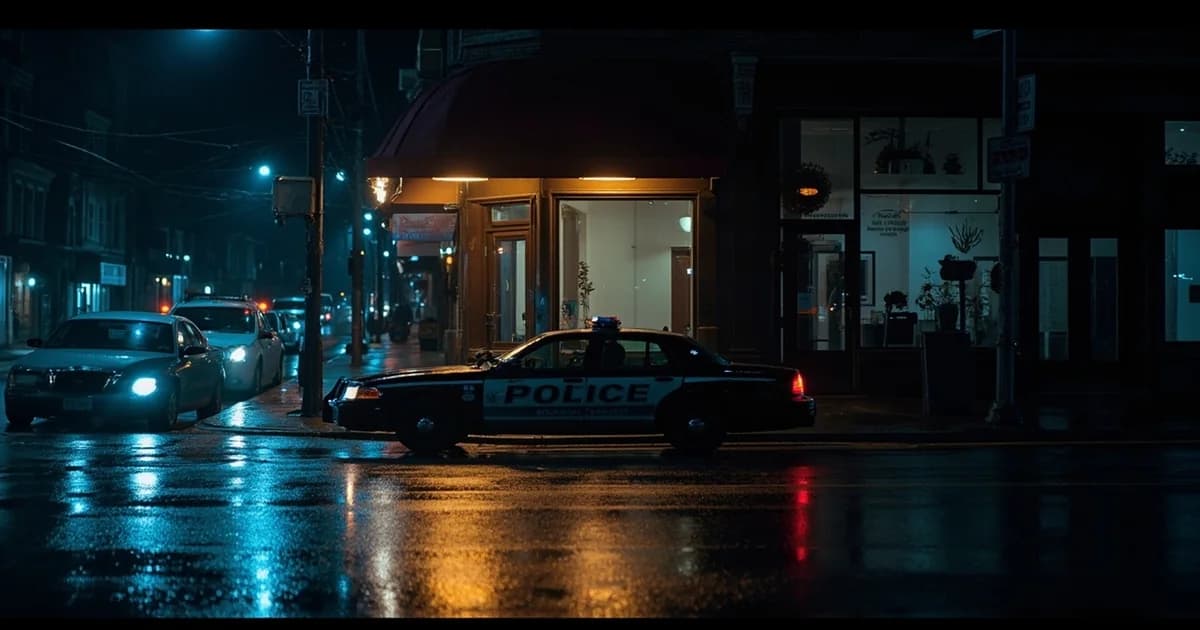
Last summer, around 2 a.m., I was driving home alone, dressed like what I was — someone who'd been playing poker late and looked like it. I turned onto Girard near the McDonald's and a cop pulled me over.
I was confused and a little scared. Not scared of the officer — scared of the ticket. I knew I looked like someone out late who had no good reason to be out. I hadn't done anything wrong but I also hadn't done anything obviously right, and I remember thinking: this is going to be a $300 mistake because I didn't push the knob far enough. That was my actual worry. The citation.
He asked for my ID, told me my headlights were off. I'd turned the knob — I was sure I had — but there was a detent I hadn't pushed past. He ran my ID, came back, and let me go with a warning.
Good policing. And nobody writes about that.
The Impossible Job
Here's what I keep thinking about: police are asked to handle everything. Homelessness, mental health crises, domestic disputes, drug addiction, grief, panic. They show up to situations no human is equipped to resolve in the three minutes between the call and the arrival. Social workers, counselors, medics — none of those people are there. Just a badge and the expectation that you make the thing stop.
And then we act surprised when outcomes are inconsistent. You can't train your way out of impossible problems. You can't staff your way out of systemic ones. We add de-escalation modules and use-of-force certifications and then act surprised when an officer in the dark, with incomplete information and adrenaline flooding their system, doesn't execute the perfect response we couldn't even define in a classroom.
The job is also understaffed and underpaid relative to the risk. Officers are navigating a minefield where a mistake costs careers, lawsuits, sometimes lives. And most of them are just trying to make it through the shift without anyone dying — including themselves.
The Thankless Middle
I don't want to be the guy who says thin blue line and acts like police are above scrutiny. They're not. There are real problems with the job — with culture, with accountability, with use of force. I'm not naive about this.
But I also don't want to be the guy who can't see what's right in front of him. Most cops are not the worst version of the job. They put on the uniform and try to do it right, and most of them do.
The Girard traffic stop was a small moment. Professional the whole way through — he did his job, I went home. That's most of what policing is.
The motorcycle cops and the Girard officer don't make the news. They're not hashtags or audit reports. They just do the job, and sometimes a kid gets to sit on a motorcycle for a minute and that becomes part of someone's Sunday. I want to remember that. Not because it excuses the institution, but because it's true, and the truth is more complicated than the takes allow.
Seeing Clearly
The job is real. The people are mostly trying. And the support is catastrophically insufficient. We built an infrastructure of expectation without an infrastructure of resources.
My son won't remember the motorcycle. He was five months old. But I will. I think about that officer sometimes — the helmet, the way he lifted my boy onto the seat like it was nothing, like it was part of the job.
That's the job. Most of the time nobody notices.
Sometimes the numbers do. In the 9th District this past summer, theft from auto fell 40% year-over-year while total violent crime fell 8% — see From One Guy Who Doesn't Want to Buy Another Car Window for what that looks like from the receiving end. The work above the fold of any given week is the work that produces those numbers. The traffic stops, the patrol presence, the community ties. Nobody writes about the empty sidewalk on a Saturday morning because the car-window-smashings stopped. But that's the job too.