Part 6 of 9 in Philadelphia Code: Accidental Anthropology
The Horse Code
Philadelphia Code § 10-108 was the most detailed municipal horse welfare law in the country. The industry ended in 2023. Council banned it June 2026.
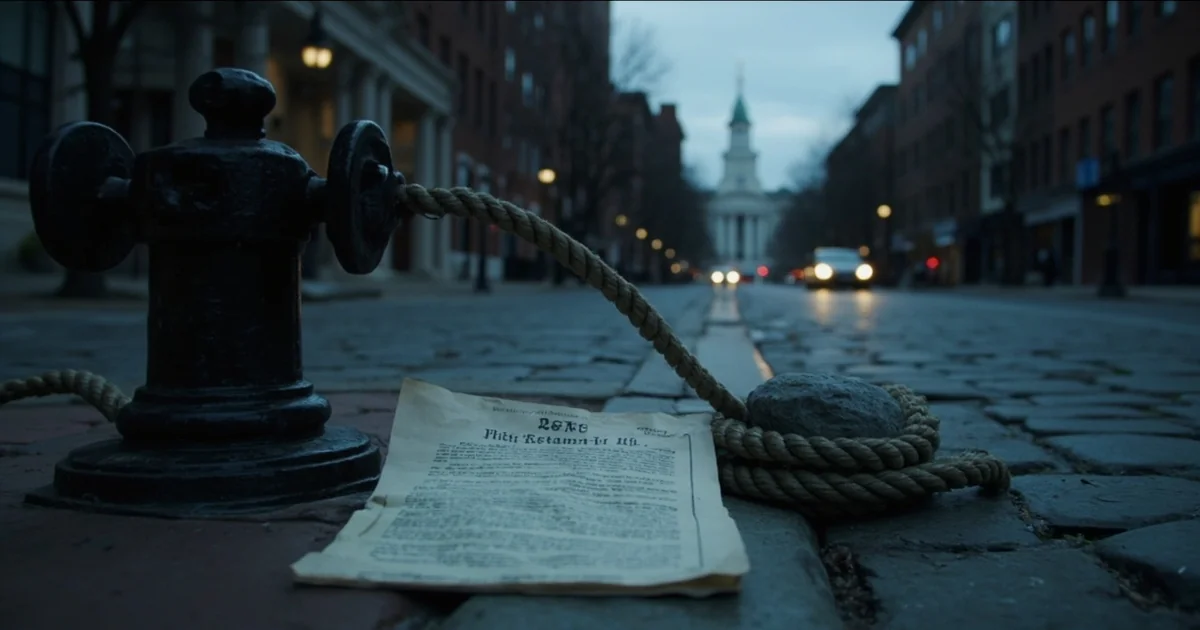
The horses are gone. The statute that governed them is still here. Section 10-108 of the Philadelphia Code was, by any reasonable accounting, the most detailed municipal horse welfare law in the United States — 1,200 words, five main sections, fifteen subsections, organized around a single premise: that a working animal should be treated as an auditable system, not a vibe. It still says what it said. The thing it described is not in it.
The Section
§ 10-108 begins at 91°F: above that, a horse cannot be worked; below 26°F, it cannot be worked either — the temperature, in both cases, delegated to the Animal Control Agency's regulations. The section then lays out a working day — nine hours maximum, in any continuous twenty-four-hour period, with at least 15 minutes of rest for every pulling hour, which works out to 45 minutes of effort and 15 of mandated rest, and a nine-hour shift in real terms is a six-hour shift with three hours of required rest. The driver keeps a daily log, in a form prescribed by regulation, available for inspection; falsifying it is a violation of the chapter's general penalty of $150 to $300 per offense. Every horse is examined by a veterinarian before service and yearly after — for parasites, physical condition, and fitness — and the Animal Control Agency can pull a horse that shows lamed or sick, while every carriage on the street carries the operator's license number and a 24-hour complaint hotline.
Each clause is a debate that has already been had. Each number is a deal. The section reads less like a statute and more like a memorandum of understanding — the operators gave up the right to work horses in the heat, the welfare advocates gave up the right to ban the industry, the city got a database and an enforcement mechanism. Everyone got a number.
There was a real horse, with a real vet, working in real weather, in a real city.
I sat down to read § 10-108 expecting the usual animal-welfare vagueness — a cruelty statute with a fine attached and a hotline to call. What I found was a section that named a particular working animal, in a particular city, and wrote rules for both.
§ 10-108 knew all of that — when the temperature crosses 91, how many hours a horse can be in harness, and what an "official identification number" means, even if it leaves the form of the number to the Animal Control Agency's regulations. Most of the Code is broad and vague — "cruelty" statutes, "kennel" statutes, categories that read like labels on a drawer. § 10-108 is none of those things. It is specific, and a citizen can read it and verify it, and that is rarer in the Code than the statute's subject matter would suggest.
How It Got Here
The modern § 10-108 did not arrive fully formed; it accumulated in pieces — § 10-108 was first added in 1986, with the once-a-year vet exam that's been on the books continuously since. The 91°F rule arrived in 2000, by Bill No. 000217. The 2011 bill (Bill 110210-A) is the legislative high-water mark: it added the 15-minutes-per-pulling-hour rest rule and most of the modern section, and it was introduced by Councilman Bill Green with the support of ACCT Philly and the Pennsylvania SPCA. The microchip-identification option, in §§ 10-108.1 and 10-108.2, came two years after that — Bill No. 121002 (2013).
The 2011 bill is the legislative high-water mark of the welfare side. The animal-welfare community had been losing the ban-the-industry fight for years; the regulation fight was the fight they could win. The proximate cause was a 2010 Center City horse collapse on a hot day — a photograph circulated, the Inquirer ran it, and Council acted within twelve months. Press accounts at the time described the bill as intended to be a "national model" for horse welfare, and Councilman Green is reported to have used the phrase.
The bill is what a compromise looks like when it gets written into law — the operators kept the industry, the welfare side got the temperature, and the city got the audit.
Where It Fits
The 91°F number is not 91 because 91 is some natural law. It is 91 because it sits between 90 and nothing — and the surrounding cities have arrived at a remarkable range of answers to the same question. New York is the obvious comparison: the city with the largest horse carriage industry in the country runs a 90°F ceiling and an 18°F floor, with a nine-hour cap and a 15-minute rest period after every two-hour working period. Mayor de Blasio's 2014 attempt to ban the industry failed, and Council voted down a follow-on "Ryder's Law" ban bill in committee in November 2025. The industry persists, regulated but not banned. Chicago took the other route: a six-hour daily cap with rest breaks but no upper temperature rule, then a 2020 Council vote to phase out the industry entirely, effective January 1, 2021. Chicago is now a non-regulator — the question of how to balance temperature and rest was settled by ending the industry. Charleston passed a 95°F / heat-index-110 ordinance in 2017; Savannah tightened to 85°F / heat-index-100 in August 2025 (the rule is in active litigation as of late May 2026). New Orleans runs mules, not horses, on a 2018 95°F / heat-index-105 policy. Philadelphia sat, by any reasonable accounting, in the middle of this spectrum from 1986 through 2026 — closer to New York than to Chicago, with the southern cities catching up over the last decade.
What It Doesn't Do
The section did not address the underlying question: should horses be working in Center City at all? That is a political question, not a regulatory one, and Council answered it on June 11, 2026, with a ban. The section also did not address the financial structure of the industry — a driver working for piece-rate fares has a structural incentive to push the horse to keep moving, and the hours and rest rules try to constrain the incentive, but the incentive remains.
And the section does not address the horse in a stable. It covers "rental and carriage horses" only "while in use for such business," and off-hours care falls to the state's general animal cruelty statute, 18 Pa.C.S. § 5511 — the federal Animal Welfare Act does not apply, because the horses are not used in research. The city can tell a horse not to walk in 92° heat. The city cannot tell an operator how to feed the horse, when to turn it out, or what kind of stall to keep it in. That is the compromise.
Enforcement was assigned to ACCT Philly and the Philadelphia Police Department, in practice through the latter's Directive 3.6 — and almost all of the enforcement was complaint-driven. The horse had to be observed, by a member of the public, doing something the section prohibits, before anyone from the city showed up. The structural incentives all pointed in the wrong direction: the driver, paid by the trip, has an incentive to keep the horse moving; the passenger, paying for the experience, has an incentive to look the other way; the city, with limited staff, has an incentive to treat the hotline as the answer. The section was detailed and specific — and enforced, in practice, by whoever happened to be looking.
The Industry
The industry the section regulated no longer exists. By the time § 10-108 was first enacted in 1986, the working-carriage population in Center City had already collapsed from its nineteenth-century peak to the low double digits. By the 2011 bill, the city was down to a single commercial company — 76 Carriage, in operation since 1976, the only remaining licensed carriage company in the city before suspending rides in early 2023. The horses worked in three clusters: Independence Mall, the Art Museum, and the hotels along Broad Street.
On June 11, 2026, Philadelphia City Council passed an ordinance amending Chapter 10 of the Code to ban both commercial and non-commercial horse-drawn carriages, with violations carrying a $1,000-per-day fine; the ordinance takes effect June 26, 2026. Section 10-108, in its current form, is the law that governed a now-ended industry.
The Position
I did not have a position on the carriage horse industry when I started this piece — I did not ride the carriages, did not organize against them, did not think the operators were cruel, did not think the welfare advocates were wrong. I thought the debate was a real one, and the section was the city's current best attempt to manage it. Council has now answered the debate differently than the section did.
What I do have a position on is the section itself. It is a piece of municipal law that took the work seriously — it did not trust the operators, did not trust the welfare advocates, did not trust the city, and so it wrote rules, assigned numbers, published them, and let the public read them. That is what municipal law is for, when it is working: not to settle the moral question, but to write a rule that everyone can read, and that the city can enforce. The Code carries other names that point to abolished or ended offices the same way — I worked through three of them in Ghost Agencies.
Section 10-108 is the kind of rule that, if the city wrote more of them, we would all be better off. Specific. Auditable. Enforceable. Updated. The horses of Philadelphia, by accident, ended up with the best piece of municipal law in the Code — and, by a longer political arc, with a Council that decided the rules were not enough, and ended the industry anyway. Both facts are true. Neither one cancels the other. The horse-code story is part of why I argue, in Give Every Law an Expiration Date, that local laws should run on a sunset clock — so a section like § 10-108 does not have to wait twenty years for a ban to be re-examined.
Sources
The statute itself is Philadelphia Code § 10-108 (Rental and Carriage Horses), with the 2011 amendment noted as Bill No. 110210-A (approved May 25, 2011) and the 2000 amendment as Bill No. 000217 (approved August 11, 2000). The companion sections on general horse licensing and private keeping — § 10-108.1 and § 10-108.2 — were both added by Bill No. 121002 (approved March 5, 2013). The chapter's general penalty ($150–$300) is at § 10-115 (Penalties and Sanctions). The state-law backdrop for off-hours care is 18 Pa.C.S. §§ 5511–5511.3.
The June 11, 2026 Council vote banning commercial and non-commercial horse-drawn carriages is reported in the Philadelphia Inquirer ("City Council votes to ban horse-drawn carriages in Philadelphia") and CBS Philadelphia ("Philadelphia City Council bans carriage horse businesses"); the underlying ordinance takes effect June 26, 2026.
The 2010 Center City horse collapse is reported in the Inquirer and the Daily News; the specific date, street corner, and name of the horse are not anchored in a single primary source, and the article cites the collapse as a general historical episode that motivated the 2011 bill, not as a fully sourced event. The "national model" line attributed to Councilman Bill Green is from press coverage of the 2011 bill; I was not able to confirm a verbatim primary-source quote. The temperature measurement location described in press coverage as Philadelphia International Airport is not specified in the Code itself, which delegates the operational question to the Animal Control Agency's regulations.
The Philadelphia Police Department's enforcement role is set out in Directive 3.6.
The comparative rules for New York (NYC Admin Code §17-330), Chicago (carriage operations banned effective January 1, 2021), Savannah (the August 2025 85°F / heat-index-100 ordinance is in active litigation as of late May 2026), Charleston (the 2017 95°F / heat-index-110 ordinance), and New Orleans (the 2018 mule heat policy, 95°F / heat-index-105, measured at Lakefront Airport) are summarized from each city's published rules as of June 2026.