Can One Family Improve Philadelphia's Abandoned Car Problem Through the 311 System? We Tried.
On a spur of the moment decision, my family and I decided to do our part to help identify abandoned cars in the open 311 tickets. A story of 3 miles, 90 minutes a 19 month old, and 15 abandoned cars
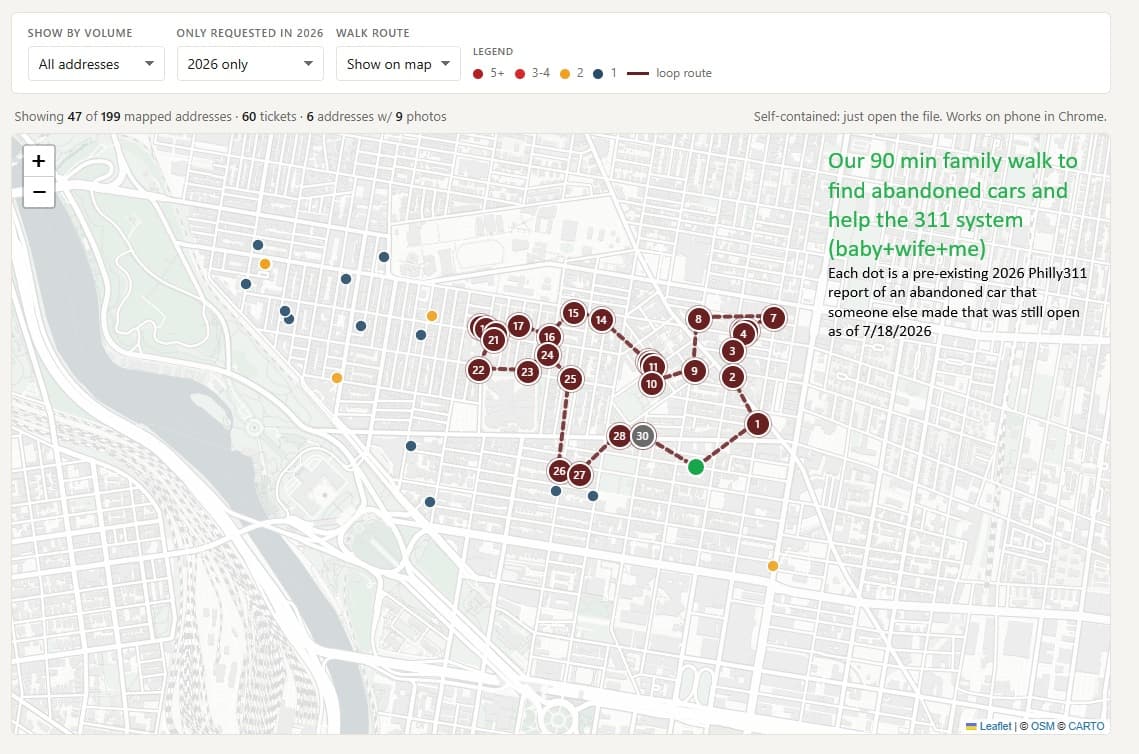
On Saturday morning my wife and I got to talking about the 311 research I've been doing. She made a really good point: it's one thing to analyze the data, but why not see if we can make a difference. And she had a practical idea. Walk to a handful of the abandoned cars, take photos where they're still sitting, submit them to police with the documentation the police actually need to act.
We noticed many reports lacked enough detail that someone unfamiliar with the street would likely have difficulty identifying the exact vehicle. We wondered whether ordinary residents could measurably improve the abandoned-vehicle process simply by giving the city better information.
So a few hours later, we turned it into a small family project, trying to do something useful for our neighborhood in Fairmount. We pulled down a subset of my 311 data for abandoned cars where 311 tickets were still open, planned a walking route to hit the open tickets nearby, and went for a walk. It was her, my 19-month-old in a stroller and me. Over the course of 90 minutes, we walked about 3 miles and stopped at 15 addresses where 311 had an open abandoned-vehicle ticket in 2026, including 2 new abandoned cars we found by coincidence. Along the way we ran into friends with a little girl a few months older than Max (happy coincidence) and planned dinner for tomorrow night.
At each stop, either because it was planned or because we found something new, we took photos and a video (where I voiced dictated the make, model, color, and license plate and other important features) that we could refer back to when we got home.
The walk
The 15 addresses came from the public abandoned-vehicle tickets from my broader 311 data analysis, filtered for my zipcode of 19130 and for ones that were issued in 2026 and still open.
For the 2 cars that weren't already on the open list, I filed new 311 tickets through the city's web form and attached the packet. For the 6 cars that were still there and already had open 2026 tickets, we filed new tickets and will call the police and a councilmember later this week to encourage faster action, as most of these open tickets have been live for 3-6 months, meaning they are overdue to be gotten rid of. In addition, I plan to email the police with all the detailed info to make their jobs easier.
What we found
Of the 15 addresses, 13 already had an open 2026 abandoned-vehicle ticket and 2 didn't. We filed the 2. Of the 13 existing tickets:
- 7 of 13 open tickets had already been resolved in reality but were still listed as open. The car had moved — the owner probably took it back, or it had been towed at some point — and the 311 status field never caught up.
- 6 were still there. Of those 6, 2 were duplicate tickets for the same car, filed months apart: 846 Perkiomen Street (ticket
19720271) and 842 Perkiomen Street (ticket19720304). Two tickets for one vehicle, parked mid-block, matching both descriptions.
The headline number is the seven, meaning fifty-four percent of the "open" abandoned-vehicle tickets at the addresses I walked were already solved. So the city should, in part, get credit for solving these issues, even if they forgot to mark them as closed.
If you're a Councilmember looking at your dashboard and seeing "13 open abandoned-vehicle tickets in this zip," what you're actually looking at, based on the 15 I walked, is more like "6 open tickets plus 7 quiet resolutions that nobody recorded." The system is overstating the backlog by roughly a factor of two at addresses like these.
A note on method, briefly
Fifteen sites is a small sample, but it's not bad for a family taking a planned walk for ninety minutes with a baby stroller. But there's only 264 open abandoned vehicle tickets in Fairmount, so in just 90 minutes my family and I validate about 5.6% of the total abandoned car tickets in our entire zip. If just 20 other Philadelphians or families did the same, we would validate all the existing abandoned car issues (or potholes, or streetlights, or whatever) and make the job easier for the City employees who have to solve the problem. Imagine how much easier it would be for them if they knew exactly what they were looking for and where?
Residents know what's happening on their block. City employees have the authority and equipment to solve problems. The 311 system is supposed to connect those two things. If residents provide better information, and if the city can act on it, everyone benefits. That's what we're hoping to test over the next few months.
This was our first attempt to make a concrete difference in our community, building off the 311 research I've done over the past few months. The kind of neighborhood-level noticing that walks like this produce — what is actually on the sidewalk you have walked a thousand times — is also what led me to the orange stick figures scratched into a patch of dirt in Fairmount by the anonymous street artist stikman, which I wrote about in a piece called The Little Orange Robot in the Dirt.
We plan do another couple of these walks, and also collaborate with the police, our local ward leader and our councilperson to help resolve these issues.
Notes, Sources, and Methodology
There were roughly 60 open abandoned-car tickets for 2026 in the public 311 dataset. We picked 13 of those within walking distance of our house.
Methodology. For each location we walked to, we recorded if the original car was still there. Sometimes this was difficult because the original ticket didn't contain a photo, make, or model. When the car was there, we recorded it as such, including more detailed information such as make, model, license plate, color, and any distinguishing features (flat tires, broken windows, etc.). When the car was no longer there, we recorded that too.